

Consumer watch
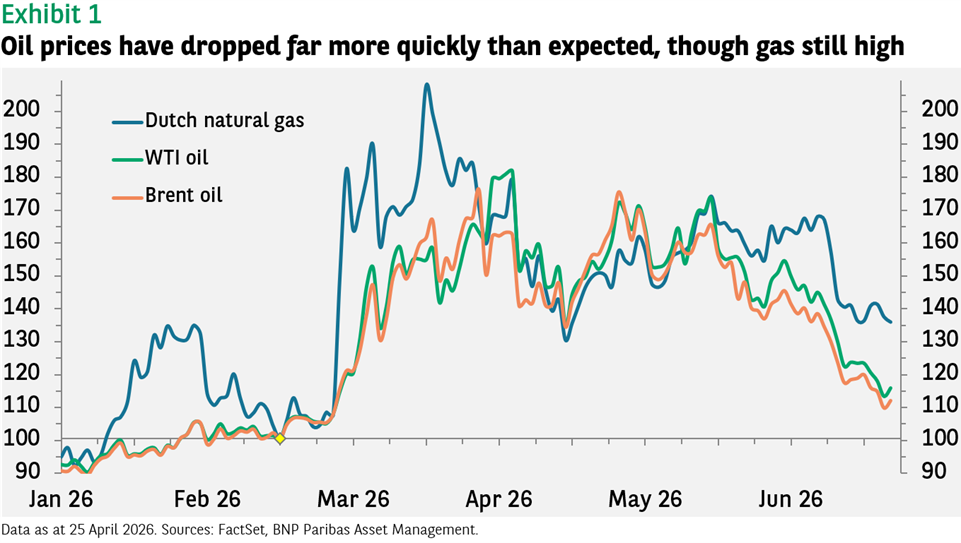
Oil prices dropped far more quickly than many analysts expected following the announcement of the Memorandum of Understanding between the US and Iran.
Despite delays in restoring traffic through the Strait of Hormuz and damage to infrastructure in the Middle East, oil prices have moved back towards pre-war levels, if not quite the lows reached in January. Importantly for Europe, natural gas prices are still elevated (Exhibit 1).
Equity markets have welcomed the geopolitical developments, with non-technology indices such as Russell Value or MSCI Europe gaining 2% to 3% since early June.
This performance stands in contrast to what has happened to tech stocks in the US and emerging markets, where indices have declined by 2% to 4%. The drop is a function of investor worries about excessive exuberance, particularly for Korean stocks, as leveraged ETF bets on further gains suggested markets were getting frothy.
The Nasdaq index has also had to adjust to modestly higher policy rate expectations following the hawkish press conference from the Federal Reserve in mid-June.
Economic data
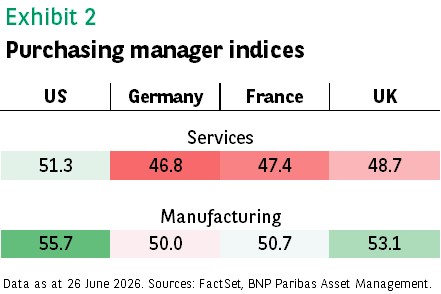
Economic data continues to point to a further acceleration of activity in the US, alongside contraction or sluggish growth in Europe. The US services sector Purchasing Managers’ Index moved further into expansionary territory (a reading above 50), while those for the major economies of Europe were well below.
The US manufacturing PMI hit its highest level in four years (despite, or because of, tariffs), while the figures for continental Europe were more modest (see Exhibit 2). To the degree that higher energy prices would have a bigger impact on manufacturing than on services, Europe’s poor services figures are worrying.
Not all the data for the US is encouraging, however. The final revision to US first quarter GDP raised the figure from 1.6% to 2.1%. Artificial intelligence-driven business investment remains strong, and the offsetting drag to growth from net exports is lower (much of the AI capital expenditure is spent on importing semiconductor chips, which worsens the trade balance).
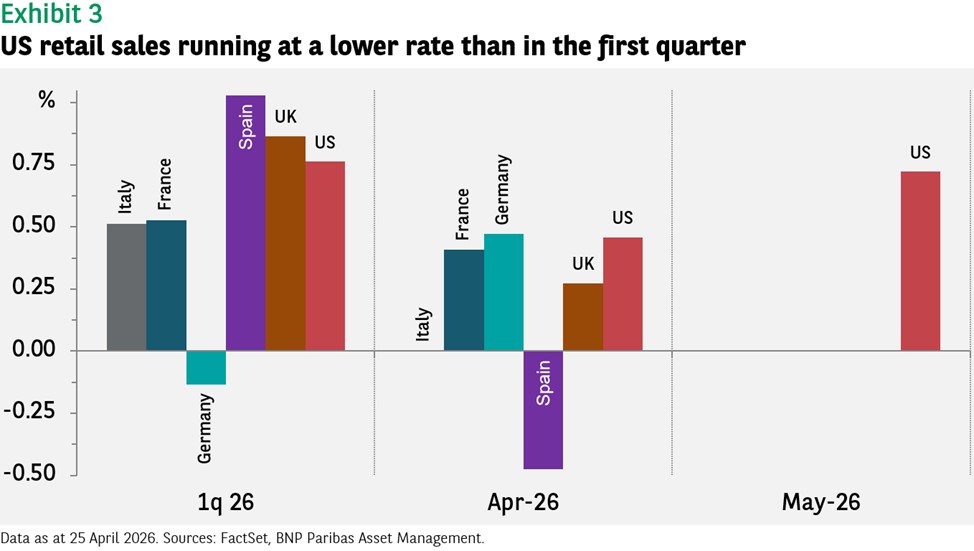
The concerning figure was consumer demand, which was revised down from an already low 1% to 0.4%. The long-run, non-recessionary average for PCE (personal consumption expenditures) is 2%. The data suggests that the US consumer may be struggling.
Anticipating what the PCE figure for the second quarter might turn out to be, US retail sales have been running at an even lower rate, though this is true for most of Europe, too (see Exhibit 3).
With business activity evidently still robust, the consumer remains the key vulnerability to US equity markets.
Data sources: FactSet, BNP Paribas Asset Management as of 25 June 2026 (unless otherwise stated). Past performance should not be seen as a guide to future returns.


Disclaimer
The information on this website is intended for investors domiciled in Switzerland.
AXA Investment Managers Switzerland Ltd (Part of BNP Paribas Group) is not liable for unauthorised use of the website.
This website is for advertising and informational purpose only. The published information and expression of opinions are provided for personal use only. The information, data, figures, opinions, statements, analyses, forecasts, simulations, concepts and other data provided by AXA Investment Managers Switzerland Ltd (Part of BNP Paribas Group) in this document are based on our knowledge and experience at the time of preparation and are subject to change without notice.
AXA Investment Managers Switzerland Ltd (Part of BNP Paribas Group) excludes any warranty (explicit or implicit) for the accuracy, completeness and up-to-dateness of the published information and expressions of opinion. In particular, AXA Investment Managers Switzerland Ltd (Part of BNP Paribas Group) is not obliged to remove information that is no longer up to date or to expressly mark it a such. To the extent that the data contained in this document originates from third parties, AXA Investment Managers Switzerland Ltd (Part of BNP Paribas Group) is not responsible for the accuracy, completeness, up-to-dateness and appropriateness of such data, even if only such data is used that is deemed to be reliable.
The information on the website of AXA Investment Managers Switzerland Ltd (Part of BNP Paribas Group) does not constitute a decision aid for economic, legal, tax or other advisory questions, nor may investment or other decisions be made solely on the basis of this information. Before any investment decision is made, detailed advice should be obtained that is geared to the client's situation.
Past performance or returns are neither a guarantee nor an indicator of the future performance or investment returns. The value and return on an investment is not guaranteed. It can rise and fall and investors may even incur a total loss.
AXA Investment Managers Switzerland Ltd (Part of BNP Paribas Group)
__________________________________________________________________________
AXA IM and BNPP AM are progressively merging and streamlining our legal entities to create a unified structure
AXA Investment Managers joined BNP Paribas Group in July 2025. Following the merger of AXA Investment Managers Paris and BNP PARIBAS ASSET MANAGEMENT Europe and their respective holding companies on December 31, 2025, the combined company now operates under the BNP PARIBAS ASSET MANAGEMENT Europe name.