

How can investors assess and measure a company’s impact on biodiversity?
KEY POINTS
Biodiversity loss is an existential threat to both people and the planet. However, we believe listed assets investment strategies can help deliver significant positive impacts and help stem the deterioration of the world’s fragile ecosystems.
Ensuring corporates are doing the right thing by biodiversity is vital. Thankfully policy momentum worldwide and an ever-expanding appreciation of biodiversity’s role in economies and climate change is helping drive global commitments to stop biodiversity loss by 2030, and to have a net positive impact on biodiversity from 2050 onwards.
What is being done to combat biodiversity loss right now?
A growing awareness of threats to biodiversity has propelled greater regulatory and industry efforts over time. Most recently, at the United Nations biodiversity conference COP15 in December 2022, countries reached a landmark agreement, adopting the Post-2020 Global Biodiversity Framework (GBF) – biodiversity’s equivalent to the Paris Agreement on climate change.
The GBF – also known as the Kunming-Montreal Agreement - provides all stakeholders globally with clear goals and a roadmap to halt and reverse biodiversity loss by 2030 to achieve a shared vision for “living in harmony with nature by 2050”.
It sets out 23 specific targets under four overarching goals. Among the most cited is the GBF’s so-called ‘30 by 30’ target: To conserve and protect at least 30% of the world’s land and seas by 2030

As governments work to translate these targets into national strategies and action plans, industry momentum continues to grow. These strategies could serve as powerful catalysts, and act as a basis for enhanced synergies between governments and the private sector. Companies and financial institutions are already starting to assess their impacts on biodiversity and develop initiatives to combat biodiversity loss.
While these are still nascent, the GBF is arguably providing additional impetus through several of its targets
In addition, two key international standards were issued in 2023. The Science Based Targets Network (SBTN) released beta target setting guidance which companies began pilot testing
Measuring biodiversity
One of the most common ways to try and measure a company’s impact on biodiversity is through a biodiversity footprint. There is currently no broadly accepted metric for this
At AXA IM, we use a metric called the Corporate Biodiversity Footprint (CBF), developed by Iceberg Data Lab
For now, the CBF measures only negative impacts, in absolute terms, and expressed spatially in square kilometres (km²) of mean species abundance (MSA) – a recognised proxy for the intactness of biodiversity compared to a pristine, undisturbed state. For example, a CBF of -100km² MSA would tell us that the pressures generated by a company’s activities during a given year are estimated to have degraded entirely the biodiversity of an area equivalent to 100km².
The CBF can be broken down by scope (1, 2 and 3, as for climate)
We use this metric to help us identify the sectors contributing the most to biodiversity loss as well as companies with material exposures which in turn helps us to identify companies we may want to engage with. In addition, we include the CBF in our standard environmental, social and governance reporting at portfolio level as part of our wider commitment to transparency to clients.
Sectors contributing most to biodiversity loss
Corporate Biodiversity Footprint of MSCI All Country World (km².MSA)
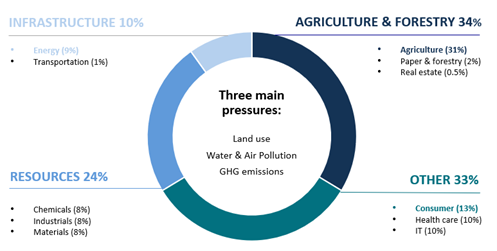
Source: AXA IM, Iceberg Data Lab as at 30/09/2023. Index use: MSCI All Country World. Corporate Biodiversity Footprint in km².MSA (Mean Species Abundance). For Illustrative purposes only.
In addition to the CBF, which we can provide across a wide range of portfolios, we also recognise the need to measure specific biodiversity key performance indicators (KPIs) for our dedicated listed equity biodiversity strategies. These are managed using our AXA IM Listed Impact Framework which consists of five pillars, one of the five being measurement which looks at company and portfolio level KPIs. Examples of KPIs include acres of sustainable farming and tonnes of waste materials collected and processed.
We also measure investor contribution by tracking the progress of our engagement activities. Recognising the importance of demonstrating these strategies are indeed having both a positive and measurable impact, we provide our investors with an Annual Impact Report.






Disclaimer
The information on this website is intended for investors domiciled in Switzerland.
AXA Investment Managers Switzerland Ltd (Part of BNP Paribas Group) is not liable for unauthorised use of the website.
This website is for advertising and informational purpose only. The published information and expression of opinions are provided for personal use only. The information, data, figures, opinions, statements, analyses, forecasts, simulations, concepts and other data provided by AXA Investment Managers Switzerland Ltd (Part of BNP Paribas Group) in this document are based on our knowledge and experience at the time of preparation and are subject to change without notice.
AXA Investment Managers Switzerland Ltd (Part of BNP Paribas Group) excludes any warranty (explicit or implicit) for the accuracy, completeness and up-to-dateness of the published information and expressions of opinion. In particular, AXA Investment Managers Switzerland Ltd (Part of BNP Paribas Group) is not obliged to remove information that is no longer up to date or to expressly mark it a such. To the extent that the data contained in this document originates from third parties, AXA Investment Managers Switzerland Ltd (Part of BNP Paribas Group) is not responsible for the accuracy, completeness, up-to-dateness and appropriateness of such data, even if only such data is used that is deemed to be reliable.
The information on the website of AXA Investment Managers Switzerland Ltd (Part of BNP Paribas Group) does not constitute a decision aid for economic, legal, tax or other advisory questions, nor may investment or other decisions be made solely on the basis of this information. Before any investment decision is made, detailed advice should be obtained that is geared to the client's situation.
Past performance or returns are neither a guarantee nor an indicator of the future performance or investment returns. The value and return on an investment is not guaranteed. It can rise and fall and investors may even incur a total loss.
AXA Investment Managers Switzerland Ltd (Part of BNP Paribas Group)
__________________________________________________________________________
AXA IM and BNPP AM are progressively merging and streamlining our legal entities to create a unified structure
AXA Investment Managers joined BNP Paribas Group in July 2025. Following the merger of AXA Investment Managers Paris and BNP PARIBAS ASSET MANAGEMENT Europe and their respective holding companies on December 31, 2025, the combined company now operates under the BNP PARIBAS ASSET MANAGEMENT Europe name.